
Commercial refrigerators do more than keep food cold. For restaurants, cafés, grocery stores, convenience stores, bakeries, hotels, schools, and commercial kitchens, they protect customers, reduce food waste, and help businesses stay compliant with food safety requirements.
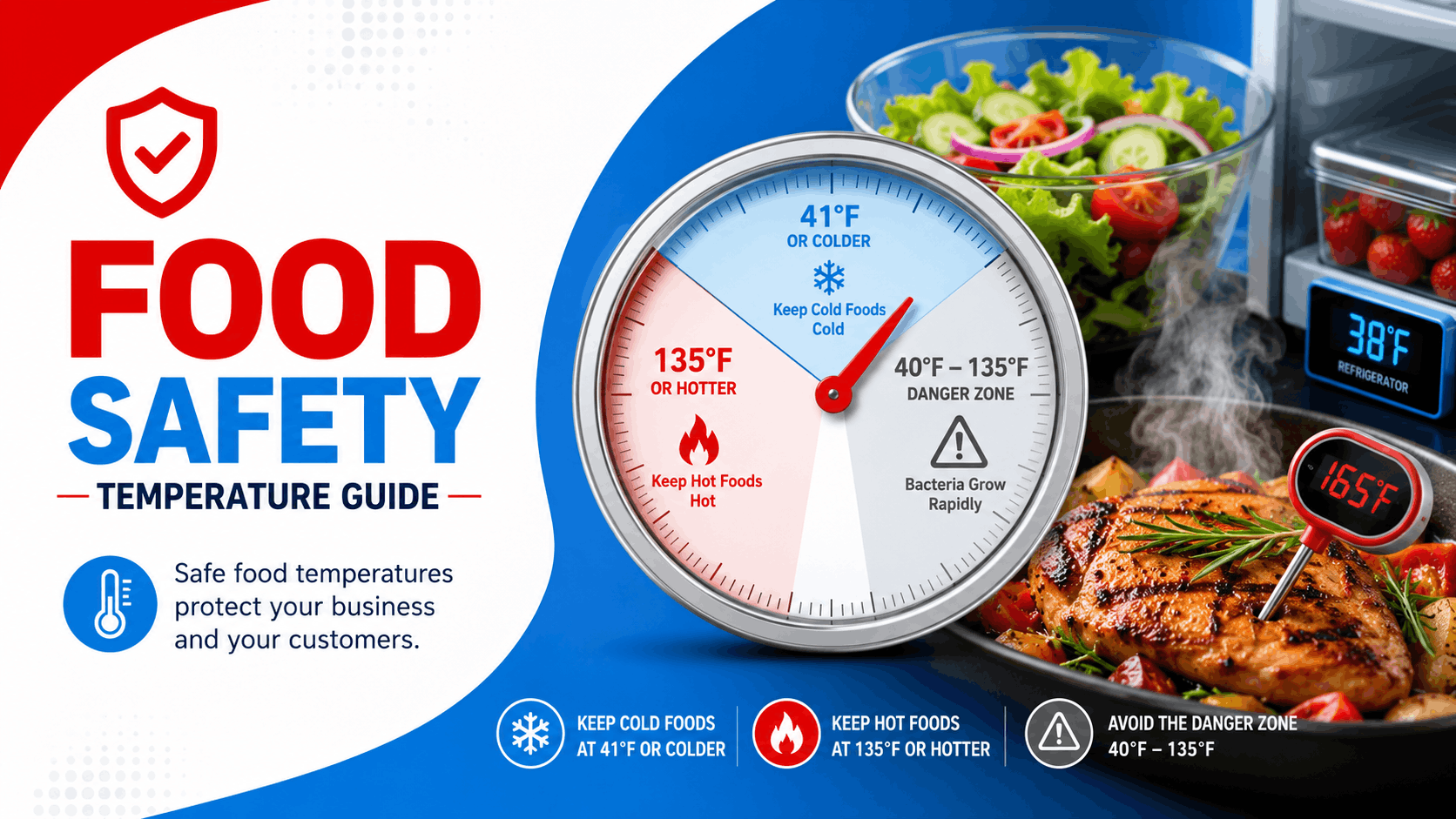
When a commercial refrigerator rises above the safe temperature range, high-risk foods can enter the temperature danger zone. That creates the right environment for bacteria to grow, especially in foods that require time and temperature control for safety, often called TCS foods.
In Minnesota food establishments, refrigerated TCS foods should be held at 41°F or below, while general FDA consumer guidance recommends keeping refrigerators at 40°F or below and freezers at 0°F.
The table below gives a clear starting point for safe food storage and commercial refrigeration monitoring.
| Area or Equipment | Safe Temperature Guideline | Why It Matters |
|---|---|---|
| Commercial refrigerator holding TCS food | 41°F or below | Required cold holding range for TCS foods in Minnesota food operations. |
| Recommended operating range | 36°F–38°F | Gives your unit a safety buffer during door openings, rush hours, and restocking. |
| Freezer | 0°F or below | Keeps frozen food safely frozen and protects product quality. |
| Walk-in cooler | 35°F–38°F target, food at 41°F or below | Helps maintain safe product temperatures in high-traffic kitchens. |
| Prep table / cold rail | Food must remain 41°F or below | Ingredients are exposed more often during service, so frequent checks matter. |
| Refrigerated display case | Food must remain 41°F or below | Important for customer-facing products, dairy, desserts, deli foods, and beverages. |
| Hot holding equipment | 135°F or above | Keeps hot TCS foods out of the danger zone. |
| Minnesota commercial danger zone | 41°F–135°F | Bacteria grow faster when TCS foods remain in this range too long. |
Minnesota food safety guidance identifies the danger zone as 41°F to 135°F, while USDA and FDA public guidance often describes the danger zone as 40°F to 140°F. For Minnesota commercial kitchens, restaurants, and food businesses, the safer working rule is simple: keep cold TCS foods at 41°F or below, and avoid letting them sit in the danger zone.
Food safety problems often begin quietly. A reach-in cooler may feel cold when the door opens, but the food inside may still be warming above the safe range. A prep table may show a normal digital display while ingredients in the top rail are several degrees warmer.
A walk-in cooler may recover slowly after deliveries, especially if fans, gaskets, coils, or the thermostat are not working properly. The FDA notes that bacteria that cause foodborne illness can multiply quickly at room temperature and that chilling food properly is one of the best ways to slow bacterial growth.
For a commercial kitchen, poor temperature control can lead to:
If your refrigerator temperature keeps rising, drops slowly, or fluctuates throughout the day, contact Merit Appliance Repairs for commercial refrigerator troubleshooting in the St. Paul and Minneapolis metro area.
Book Commercial Refrigerator ServiceNot every food carries the same risk. Commercial kitchens must pay special attention to TCS foods because they can support the growth of harmful bacteria when held at unsafe temperatures.
| TCS Food Category | Common Examples | Safe Cold Holding Rule |
|---|---|---|
| Animal-origin foods | Meat, poultry, seafood, eggs, milk, cooked meat | Hold at 41°F or below |
| Cooked plant foods | Cooked rice, potatoes, pasta, beans | Hold at 41°F or below |
| Cut produce | Cut melons, cut tomatoes, cut leafy greens | Hold at 41°F or below |
| Prepared mixtures | Chicken salad, tuna salad, egg salad, deli salads | Hold at 41°F or below |
| Ready-to-eat refrigerated foods | Sandwiches, sauces, desserts, prepared meals | Hold at 41°F or below |
| Garlic-in-oil mixtures | Unless specially processed for safety | Hold at 41°F or below |
Minnesota food safety guidance lists examples of TCS foods such as raw or cooked animal foods, cooked plant foods, cut melons, cut tomatoes, cut leafy greens, and certain mixtures that may allow bacteria or toxin formation.
Different refrigeration units face different temperature challenges. A walk-in cooler handles large inventory and frequent traffic. A prep table is opened constantly during service. A display case must protect food while also presenting it attractively to customers.
| Equipment Type | Temperature Goal | Common Risk |
|---|---|---|
| Walk-in cooler | Keep food at 41°F or below | Door traffic, blocked airflow, fan issues, coil problems |
| Reach-in refrigerator | Keep food at 41°F or below | Overloading, worn door gaskets, thermostat failure |
| Under-counter refrigerator | Keep food at 41°F or below | Poor ventilation, compressor stress, warm kitchen conditions |
| Prep table / sandwich unit | Keep ingredients at 41°F or below | Open lids, warm pans, food stacked too high |
| Refrigerated display case | Keep products at 41°F or below | Air curtain disruption, lighting heat, customer access |
| Bar refrigerator | Keep beverages and perishables safely cold | Frequent door openings and dirty condenser coils |
| Walk-in freezer | Keep frozen food frozen, ideally 0°F or below | Frost buildup, door seal leaks, defrost problems |
A good rule for commercial kitchens is to set equipment colder than the legal limit so food remains safe during normal use. For example, if food must stay at 41°F or below, many operators aim for an air temperature around 36°F–38°F to create a safety buffer.
The built-in display on a commercial refrigerator is helpful, but it should not be your only source of truth. Some displays measure air temperature near a sensor, not the actual temperature of food in the warmest part of the unit.
Use this monitoring checklist:
A temperature log gives your team a simple way to track performance and respond before food safety is compromised.
| Date | Time | Unit Name | Air Temp | Food/Product Temp | Corrective Action | Staff Initials |
|---|---|---|---|---|---|---|
| July 9 | 8:00 AM | Walk-In Cooler | 37°F | 39°F | No action needed | AB |
| July 9 | 12:30 PM | Prep Table | 42°F | 43°F | Moved food to backup cooler, called service | AB |
| July 9 | 5:00 PM | Display Case | 38°F | 40°F | No action needed | AB |
For health inspection readiness, your log should show more than numbers. It should show that your team noticed problems and took action.
If your temperature log shows repeated readings above 41°F, do not keep adjusting the thermostat and hoping the issue disappears. Contact Merit Appliance Repairs for professional refrigerator repair and diagnostics before product loss becomes more expensive than the repair itself.
Get Refrigerator Repair HelpTemperature control is not only about storage. It also matters when cooling cooked foods, prepared foods, and bulk ingredients.
Minnesota guidance states that TCS food must be cooled from 135°F to 70°F within 2 hours, then completely cooled to 41°F or below within 6 hours. TCS food prepared from room-temperature ingredients must be cooled to 41°F or below within 4 hours.
| Cooling Situation | Required Cooling Standard |
|---|---|
| Hot cooked TCS food | 135°F to 70°F within 2 hours |
| Full cooling process | 135°F to 41°F or below within 6 hours total |
| Room-temperature prepared TCS food | Cool to 41°F or below within 4 hours |
| Best cooling methods | Shallow pans, smaller batches, stirring, uncovered cooling, proper airflow |
Best practices for faster cooling include:
A commercial refrigerator that cannot pull food down to safe temperatures may have a mechanical issue, airflow restriction, dirty condenser coil, weak compressor, thermostat problem, or door seal failure.
Refrigerator failure needs quick action. Waiting too long can make food unsafe even if it still looks or smells normal.
FoodSafety.gov states that a refrigerator can keep food safe for up to 4 hours during a power outage if the door stays closed. It also advises discarding refrigerated perishable foods such as meat, poultry, fish, eggs, and leftovers after 4 hours without power.
| Situation | What to Do |
|---|---|
| Power outage under 4 hours | Keep doors closed and monitor temperatures. |
| Food above 40°F/41°F for less than 2 hours | Move food to working refrigeration and document action. |
| Perishable food above 40°F for more than 2 hours | Discard high-risk foods according to safety guidance. |
| Freezer food still has ice crystals | It may be safe to refreeze or cook if temperature stayed at 40°F or below. |
| Cooler repeatedly rises above safe range | Stop using it for TCS foods and schedule repair. |
If a walk-in cooler, reach-in refrigerator, display case, prep table, or commercial freezer fails during business hours, call Merit Appliance Repairs for fast commercial refrigeration troubleshooting in the St. Paul and Minneapolis metropolitan area.
Request Service NowMany commercial refrigeration issues start small. A cooler may only run a few degrees warm at first, but that can still be enough to put TCS food at risk.
Dust, grease, and kitchen debris can collect on condenser coils. When coils cannot release heat properly, the refrigerator works harder and may struggle to maintain safe temperatures.
A bad thermostat can cause inaccurate readings, short cycling, or poor temperature control. This may make the unit appear operational while food temperatures rise.
The compressor is the heart of the refrigeration system. If it weakens or fails, the refrigerator may run constantly without cooling properly.
Evaporator and condenser fans move air through the system. If a fan fails, cold air may not circulate evenly, causing warm spots inside the unit.
Loose, cracked, or dirty door gaskets allow warm air to enter. This makes the unit work harder and increases the risk of temperature fluctuation.
Overpacked shelves, blocked vents, and poor product spacing can prevent cold air from circulating around food.
Low refrigerant, leaks, or sealed system failures can reduce cooling power and require professional diagnosis.
Merit Appliance Repairs handles common commercial refrigerator issues such as defective motors, defective compressors, dirty condenser coils, faulty thermostats, leaking water, broken ice makers, and noisy operation.
Preventive maintenance helps commercial refrigerators stay efficient, reliable, and food-safe.
| Frequency | Maintenance Task |
|---|---|
| Daily | Check and log temperatures. Make sure doors close fully. |
| Daily | Keep food covered and avoid overloading shelves. |
| Weekly | Clean spills, inspect gaskets, and check for unusual noise. |
| Monthly | Clean accessible condenser areas and check airflow. |
| Monthly | Inspect drain lines, fan operation, frost buildup, and door seals. |
| Quarterly or Semiannually | Schedule professional inspection for high-use commercial units. |
| Immediately | Call for repair if temperatures rise, fluctuate, or recover slowly. |
Preventive care is especially important for businesses that rely on walk-in coolers, prep tables, refrigerated display cases, bar coolers, and reach-in refrigerators during long service hours.
Call a professional when you notice:
A quick repair can often prevent larger equipment failure, emergency food disposal, and business interruption.
If your commercial refrigerator is not holding safe temperatures, contact Merit Appliance Repairs for professional commercial refrigerator repair in St. Paul, Minneapolis, and nearby Minnesota service areas.
Schedule Commercial Refrigerator RepairSafe commercial refrigeration is not just about keeping food cold. It is about keeping food consistently out of the temperature danger zone.
For Minnesota food businesses, the key rule is simple: hold refrigerated TCS foods at 41°F or below. Use thermometers, keep temperature logs, check food temperatures often, and take quick corrective action when equipment starts drifting above the safe range.
If your refrigerator, walk-in cooler, prep table, display case, or freezer cannot maintain safe temperatures, Merit Appliance Repairs can help diagnose the issue and restore reliable cooling performance before it affects your food safety, compliance, and revenue.
For Minnesota commercial food operations, refrigerated TCS foods should be held at 41°F or below. Many businesses set refrigerators around 36°F–38°F to create a safety buffer during busy service periods.
A refrigerator holding TCS foods at 45°F is not considered a safe long-term cold holding temperature for most commercial food operations. Minnesota guidance says cold TCS foods should be held at 41°F or below.
A freezer should generally be kept at 0°F or below. FDA guidance recommends 0°F for freezers and 40°F or below for refrigerators.
Restaurant staff should check commercial refrigerator temperatures multiple times per day, especially at opening, during peak service, after deliveries, and before closing.
Move high-risk foods to a working cooler, check product temperatures, document corrective action, and call a repair technician. If perishable food has been above the safe range too long, follow food safety rules and discard it when necessary.
Lowering the thermostat may help temporarily, but it does not fix mechanical problems such as dirty coils, weak compressors, bad fans, faulty thermostats, or damaged gaskets.
Merit Appliance Repairs provides commercial refrigeration troubleshooting and repair services in the St. Paul and Minneapolis metropolitan area, including service for walk-in coolers, reach-in refrigerators, under-counter units, prep tables, display cases, bar refrigeration, chef bases, blast chillers, and more.