
7 Best Window ACs for Vertical Windows in 2026
A vertical window can make an otherwise simple air-conditioner purchase surprisingly difficult. Most room ACs are shaped for double-hung windows that open upward. Casement and horizontal-slider windows need a narrower, taller unit with an approved installation kit. This guide compares five models that are currently sold or listed and two discontinued models that shoppers may still encounter.
What Is a Window AC for Vertical Windows?
“Vertical window AC” is a common shopping term, but it can describe more than one window arrangement. The product manual matters more than the marketing phrase. Before ordering a unit, identify how the window opens.
Casement window
A casement window is hinged at the side and commonly opens outward with a crank. A narrow casement AC may fit after the screen and opening sash are handled according to the installation instructions.
Horizontal-slider window
A horizontal slider moves left to right. The AC sits in the lower portion of the open side, while a tall panel or window kit closes the space above the appliance.
Double-hung window
A double-hung window opens vertically, usually by lifting the lower sash. Most conventional wide window ACs are designed for this style rather than for a tall, narrow opening.
Why orientation matters
Compressor lubrication, condensate drainage, cabinet support, and airflow are engineered around a specified position. Do not rotate a standard window unit to make it fit a narrow opening.
How We Selected These Models
The vertical-window AC category is small, and many older listicles mix genuine casement units with regular double-hung models. To keep this comparison useful, each entry was evaluated against the following criteria:
- Documented compatibility: the manufacturer or current listing must identify the unit as a casement, crank-out, or horizontal-slider model.
- Window opening requirements: minimum height, width range, and included installation components were checked where published.
- Cooling suitability: BTU capacity and the manufacturer’s recommended room coverage were prioritized over a generic square-foot formula.
- Humidity control: dehumidification data was included only when a published rate was available.
- Daily usability: fan speeds, timer, sleep mode, remote control, washable filter, and airflow direction were considered.
- Efficiency information: CEER, EER, wattage, Energy Saver mode, or an EnergyGuide link was noted without inventing missing figures.
- Ownership factors: product status, warranty, weight, parts support, and seller availability were considered.
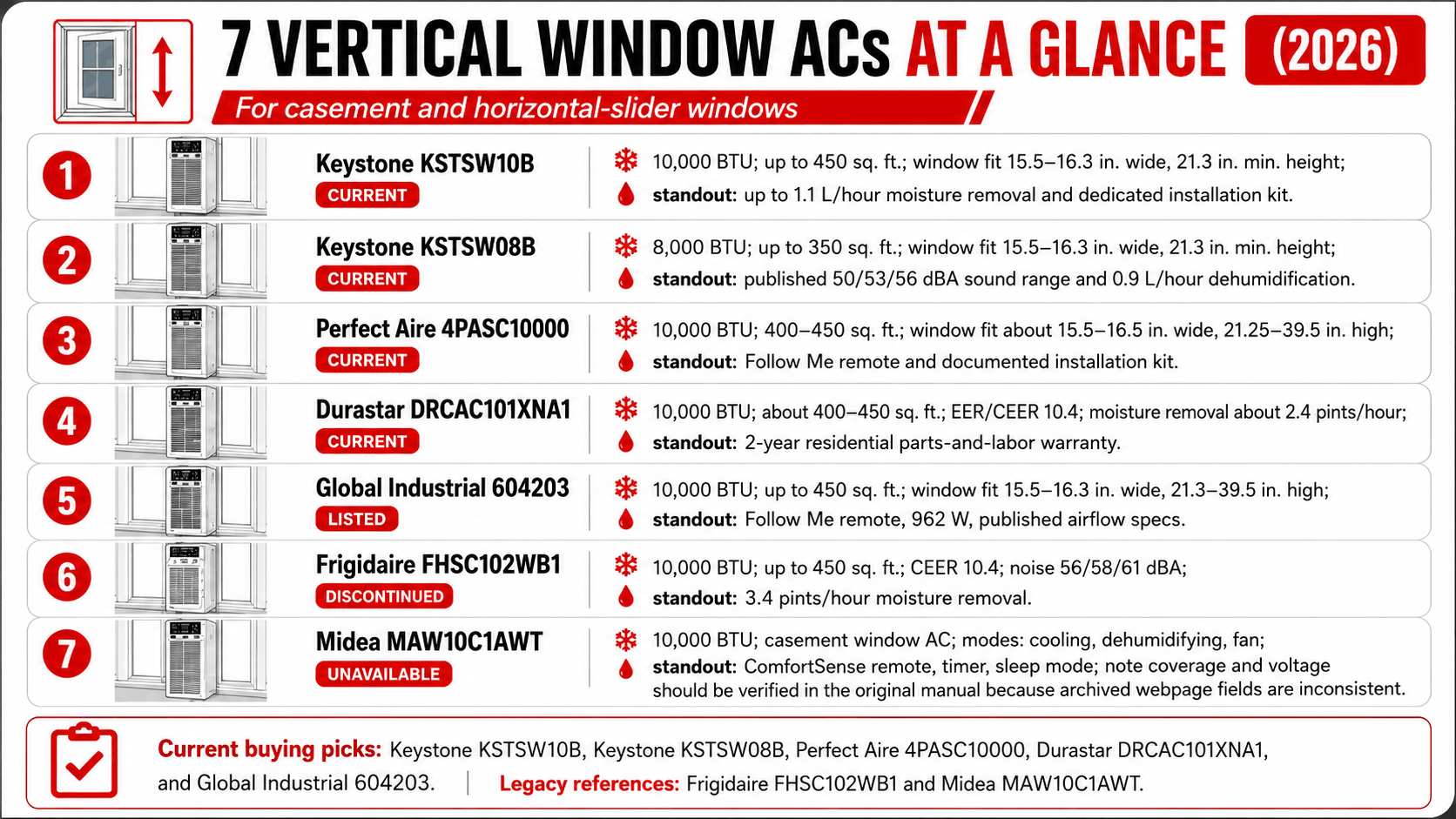
Best Vertical Window ACs at a Glance
| Model | Status | Capacity and coverage | Approved window type | Opening information | Best reason to choose it |
|---|---|---|---|---|---|
| Keystone KSTSW10B | Current | 10,000 BTU Up to 450 sq. ft. |
Horizontal slider or casement | Minimum height: 21.3 in. Width: 15.5–16.3 in. |
Balanced performance, moisture removal, and current manufacturer support |
| Keystone KSTSW08B | Current | 8,000 BTU Up to 350 sq. ft. |
Horizontal slider or casement | Minimum height: 21.3 in. Width: 15.5–16.3 in. |
Published 50–56 dBA sound range and a more suitable size for bedrooms |
| Perfect Aire 4PASC10000 | Current | 10,000 BTU 400–450 sq. ft. |
Casement, crank-out, or horizontal slider | Width: about 15.5–16.5 in. Height: about 21.25–39.5 in. |
Follow Me remote and a clearly documented installation kit |
| Durastar DRCAC101XNA1 | Current | 10,000 BTU About 400–450 sq. ft. |
Casement / left-to-right sliding | Confirm the exact range in the current manual before purchase | Two-year residential parts-and-labor warranty and 2.4 pints/hour moisture removal |
| Global Industrial 604203 | Listed | 10,000 BTU Up to 450 sq. ft. |
Slider or casement | Width: 15.5–16.3 in. Height: 21.3–39.5 in. |
Detailed dimensions, Follow Me remote, and commercial/residential positioning |
| Frigidaire FHSC102WB1 | Discontinued | 10,000 BTU Up to 450 sq. ft. |
Slider or casement | Minimum height: 21.5 in. Width: 15.5 in. |
Strong published specifications if found as legitimate remaining stock |
| Midea MAW10C1AWT | Unavailable | 10,000 BTU Archived page has inconsistent coverage data |
Casement | Use the archived manual, not reseller assumptions | Useful only as a legacy reference or replacement-parts search |
Availability note: inventory and prices can change quickly. “Current” means an active manufacturer page or current listing was found during the July 2026 review. It does not guarantee stock in every ZIP code.
Detailed Reviews of the 7 Vertical Window AC Models
Keystone KSTSW10B
Best overall vertical window AC
The Keystone KSTSW10B is the most balanced recommendation for a medium-size bedroom, office, den, or enclosed living area. Keystone explicitly states that it is designed for horizontal-slider and casement windows and that it does not work in a standard double-hung opening. Its 10,000-BTU rating is paired with manufacturer coverage of up to 450 square feet.
Why it stands out
The cooling capacity, published fit range, moisture-removal rate, washable filter, and current manufacturer page make this model easier to evaluate than many obscure casement units. It also includes a dedicated installation kit, so buyers are not starting with a standard AC and improvising its support or upper filler panel.
Pros
- Explicitly approved for horizontal-slider and casement windows
- Useful 10,000-BTU size for many 350–450-square-foot rooms
- Strong published dehumidification for humid climates
- Three fan speeds and four-way airflow control
- Washable filter, timer, sleep mode, and Energy Saver mode
Cons
- Heavy enough that two-person installation is the safer plan
- No Wi-Fi or app control listed
- Narrow window-width range requires careful measurement
- May be oversized for a small, shaded bedroom
Specification source: Keystone KSTSW10B manufacturer page.
Keystone KSTSW08B
Best for bedrooms and home offices
The 8,000-BTU KSTSW08B uses the same purpose-built concept as the larger Keystone but is rated for rooms up to 350 square feet. Its most useful distinction is a published sound range of 50 dBA on low, 53 dBA on medium, and 56 dBA on high. That does not make it silent, but it gives shoppers a real figure to compare rather than a vague “quiet” label.
Why it stands out
A correctly sized 8,000-BTU unit can be a better purchase than a 10,000-BTU model for a smaller bedroom. It reduces the risk of paying for capacity the room does not need, and the published low-speed sound rating is helpful for sleepers and remote workers.
Pros
- Purpose-built for horizontal-slider and casement windows
- Better capacity match for many bedrooms and offices
- Manufacturer publishes sound levels at all three settings
- Includes sleep mode, timer, and Energy Saver mode
- Washable filter and check-filter reminder
Cons
- Still a heavy appliance despite the lower BTU rating
- Not intended for a traditional double-hung window
- No app or voice-assistant support listed
- May struggle in a very sunny, open, or poorly insulated 350-square-foot room
Specification source: Keystone KSTSW08B manufacturer page.
Perfect Aire 4PASC10000
Best remote thermostat and documented installation kit
Perfect Aire’s 4PASC10000 is a 10,000-BTU casement-slider model for approximately 400–450 square feet. Its included Follow Me remote acts as a portable thermostat from up to 26 feet away. This can improve comfort when the unit’s built-in temperature sensor is close to the cold supply air but the occupant is sitting across the room.
Why it stands out
The manufacturer publishes unusually useful installation details. The kit includes expandable panels, a top rail, hardware, window-seal foam, and an installation manual. Perfect Aire also instructs owners to keep the unit upright for at least 24 hours before operation after transport, which is worth planning for on installation day.
Pros
- Compatible with casement, crank-out, and horizontal-slider windows
- Follow Me remote measures temperature near the user
- Three cooling speeds and three fan speeds
- Washable filter, 24-hour timer, sleep mode, and R32 refrigerant
- Clear installation dimensions and included hardware
Cons
- Manufacturer does not list smart-home compatibility
- Sound is described as quiet, but a clear dBA range is not shown on the page reviewed
- The weight makes two-person handling advisable
- Published width figures vary slightly between the kit description and specification table, so verify the current manual
Specification source: Perfect Aire 4PASC10000 manufacturer page.
Durastar DRCAC101XNA1
Best published residential warranty
Durastar’s DRCAC101XNA1 is a 10,000-BTU casement model aimed at approximately 400–450 square feet. Current specifications list an EER/CEER figure of 10.4, three fan speeds, airflow of roughly 324, 294, and 265 CFM, and moisture removal of about 2.4 pints per hour. Durastar states that its room-air products carry a two-year parts-and-labor warranty for qualifying residential use.
Why it stands out
The two-year residential warranty is the clearest differentiator. The model also has published airflow, efficiency, and humidity-removal figures, allowing a more informed comparison than products described only with marketing adjectives.
Pros
- Purpose-built 10,000-BTU casement model
- Two-year residential parts-and-labor warranty
- Published CEER/EER and airflow figures
- Useful moisture-removal rate for humid conditions
- Remote control, sleep mode, and three fan speeds
Cons
- Warranty restrictions apply to commercial and rental use
- Availability can depend on retailer and region
- Exact window-opening range should be confirmed in the current installation sheet
- No Wi-Fi feature is highlighted
Specification source: Durastar room-air product page.
Global Industrial 604203
Best commercial-style listed option
The Global Industrial 604203 is a 10,000-BTU slider/casement unit listed for rooms up to 450 square feet. It uses a narrow cabinet and a tall-window kit similar to other products in this specialized category. Current specifications list a 115-volt supply, 962 watts, a washable filter, three speeds, R32 refrigerant, and a Follow Me remote.
Why it stands out
This model has detailed dimensional data and is marketed for residential settings as well as classrooms, apartments, condos, and facilities. That makes it worth considering where institutional purchasing or commercial-supply support is convenient.
Pros
- Published unit dimensions and window-opening range
- 10,000-BTU capacity for medium rooms
- Follow Me remote and digital controls
- Washable filter and R32 refrigerant
- Published wattage, airflow, and humidity-removal figures
Cons
- Not as familiar a consumer HVAC brand as Keystone or Frigidaire
- Published noise can reach approximately 61 dBA
- Seller and warranty support should be checked before ordering
- Heavy and narrow, so careful mounting is essential
Specification source: Global Industrial 604203 listing.
Frigidaire FHSC102WB1
Best documented legacy model
The FHSC102WB1 was a well-documented 10,000-BTU slider/casement model, but Frigidaire now marks it as discontinued. It should therefore be treated as a legacy option, not the first recommendation for a new purchase. Remaining retailer stock may exist, but buyers should verify that the product is new, carries a valid warranty, and includes the high-window kit.
Why it remains relevant
The archived specifications are thorough: three fan speeds, 24-hour timer, auto fan, auto restart, Energy Saver mode, sleep mode, front filter access, R32 refrigerant, and a high-window kit. It also has the highest published moisture-removal rate in this comparison. The problem is availability and long-term support, not the original specification set.
Pros
- Detailed official performance and installation specifications
- Strong 3.4-pint-per-hour dehumidification rating
- Timer, sleep, Energy Saver, auto fan, and auto restart
- Included high-window kit in the original package
- Reasonable 72-pound weight for this category
Cons
- Officially discontinued
- Replacement inventory may be old, open-box, or seller-dependent
- Not ENERGY STAR certified according to the archived specification sheet
- High-speed noise is listed at 61 dBA
Status and specification source: Frigidaire FHSC102WB1 product-support page.
Midea MAW10C1AWT
Legacy reference, not a current recommendation
Midea’s archived MAW10C1AWT page identifies a 10,000-BTU casement window air conditioner with cooling, dehumidifying, and fan modes, a ComfortSense remote, sleep mode, and a programmable timer. The same page states that the product is no longer available. It also displays inconsistent room-coverage and electrical fields, so those values should not be copied into a buying guide without checking the original manual.
Why it is included
Shoppers may still see this model in old roundups, marketplace listings, or replacement-parts searches. Including it with a clear warning is more useful than presenting it as a current “best buy.”
Pros
- Originally designed as a casement-window model
- ComfortSense remote measures temperature near the user
- Cooling, dehumidifying, and fan modes
- Timer and sleep mode listed
Cons
- Officially no longer available
- Archived specification fields conflict with the product title
- Marketplace condition, age, and warranty may be uncertain
- Not appropriate as a primary 2026 buying recommendation
Status and feature source: Midea MAW10C1AWT archived manufacturer page.
How to Choose the Right Window AC for a Vertical Window
1. Confirm the window type before comparing BTUs
The phrase “vertical window” can be misleading. A horizontal slider creates a tall opening, while a casement window usually swings outward. Some units support both; others are labeled for casement or left-to-right sliding windows only. Read the installation manual and do not rely on a reseller title alone.
2. Match the BTU rating to the actual room
Manufacturer coverage is the best starting point. In this category, 8,000-BTU models are commonly positioned for rooms up to about 350 square feet, while 10,000-BTU models are commonly positioned for roughly 400–450 square feet. The correct choice also depends on ceiling height, direct sun, insulation, room shape, open doorways, heat-producing appliances, and the number of occupants.
| Room situation | Likely starting point | Adjustment to consider |
|---|---|---|
| Closed bedroom or office around 250–350 sq. ft. | 8,000 BTU | Move upward only for heavy sun, high ceilings, poor insulation, or substantial equipment heat |
| Closed room around 400–450 sq. ft. | 10,000 BTU | Confirm that the room is not open to a large hallway, kitchen, or adjacent space |
| Small room below about 250 sq. ft. | Seek a smaller approved solution | A 10,000-BTU unit may cycle too quickly and remove less humidity |
| Open-plan room or multiple connected rooms | Professional load review | A single window unit may not distribute air evenly, even when total square footage looks acceptable |
Oversizing is not automatically better. A large unit can cool the thermostat area quickly, shut off, and leave the room feeling humid. Undersizing can keep the compressor running for long periods without reaching the set temperature.
3. Check both cabinet size and installation range
Unit dimensions tell you whether the cabinet can enter the opening. Window-kit dimensions tell you whether the appliance can be secured and whether the space above it can be closed. These are separate questions. Record:
- Clear opening width
- Clear opening height
- Sill depth and shape
- Frame lips, locks, tracks, and crank-handle obstructions
- Exterior clearance around condenser louvers
- Distance to a properly grounded outlet
4. Compare noise using published decibels
“Quiet operation” is subjective. A manufacturer-published dBA range is more useful. For example, the Keystone KSTSW08B lists 50 dBA on low and 56 dBA on high, while the discontinued Frigidaire lists 56–61 dBA. The room’s hard surfaces, window vibration, wall construction, and installation quality can make the same rated unit sound different in two homes.
5. Look at humidity removal, not cooling alone
In South Florida and other humid climates, moisture removal strongly affects comfort. A cooler room can still feel clammy if the AC is oversized, short-cycles, or does not drain correctly. Compare a published pints-per-hour or liters-per-hour figure and keep the filter and coils clean.
6. Understand EER, CEER, wattage, and Energy Saver mode
EER and CEER relate cooling output to electrical input; a higher rating generally indicates greater efficiency under the relevant test method. Wattage helps estimate operating cost. Energy Saver mode can cycle the fan with the compressor, but it does not correct an oversized unit, leaky installation, or poor insulation.
7. Check electrical requirements
Most models in this guide use a 115-volt, grounded three-prong connection. Check amperage, plug type, outlet condition, circuit load, and manufacturer instructions. A heavy room AC should not share an overloaded circuit with high-draw appliances.
8. Compare warranty and product status
A discontinued unit can look attractive at a discount but may be harder to return, service, or match with replacement parts. Confirm whether the warranty starts from the original retail purchase, whether marketplace sellers are authorized, and whether commercial or rental use changes coverage.
How to Measure a Casement or Slider Window
- Open the window fully. Remove the screen only when the manufacturer’s installation method requires it.
- Measure the clear width. Measure the usable opening, not the full frame-to-frame glass size. Account for tracks, stops, handles, and locks.
- Measure the clear height. Measure from the supporting sill or track to the lowest permanent obstruction above.
- Measure the sill depth. Note sloped surfaces, raised lips, storm-window frames, and trim that may interfere with the bracket.
- Inspect the exterior. Confirm that the rear and side condenser louvers will remain outside and unobstructed.
- Check the outlet. Confirm that the factory cord reaches a grounded outlet without being pinched or stretched.
- Compare every measurement with the manual. A cabinet that physically fits may still fall outside the approved kit range.
Vertical Window AC Installation and Safety
A tall, narrow air conditioner concentrates substantial weight in a small section of the window. Most 10,000-BTU casement units weigh roughly 70–90 pounds. Use two people unless the manual and working conditions clearly make one-person handling safe.
Installation sequence
- Read the complete manual first. Identify the correct bracket, panel, fasteners, drainage position, and window restrictions.
- Keep the appliance upright. Follow any settling period specified by the manufacturer after transport. Perfect Aire, for example, instructs users to leave its unit upright for at least 24 hours before operation.
- Prepare the opening. Clean the sill and track, remove loose debris, and repair damaged wood or hardware before loading it.
- Install the support hardware. Attach the platform, bracket, top rail, or window frame components exactly as the manual shows.
- Lift and position the unit. Keep fingers clear of pinch points, protect the exterior coil, and maintain control until the AC is fully supported.
- Secure the window. Install safety screws, locks, or anti-lift devices so the sash cannot slide away from the unit.
- Close the opening above the AC. Use the approved panel or kit, then weather-strip the edges without blocking required vents.
- Check drainage and level. Follow the manufacturer’s required pitch; do not create an aggressive tilt based on a generic rule.
- Plug directly into the approved outlet. Test the LCDI/GFCI-style cord device if the manual instructs you to do so.
- Run and inspect. Listen for vibration, check that the cabinet is stable, confirm airflow, and inspect the seal for hot-air leakage.
How Much Does a Vertical Window AC Cost to Run?
The label wattage and your electricity rate provide a simple estimate. Actual consumption is lower when the compressor cycles off and can be higher when the unit runs continuously in extreme conditions.
Illustrative example: A 960-watt AC running for eight hours at an electricity rate of $0.16 per kilowatt-hour would cost about $1.23 for that day if it drew full rated power for all eight hours:
(960 ÷ 1,000) × 8 × $0.16 = $1.2288
This is not a bill prediction. Thermostat setting, outdoor temperature, sun exposure, humidity, insulation, filter condition, air leakage, and compressor cycling all affect real energy use.
Vertical Window AC vs. Portable AC vs. Mini-Split
| Cooling option | Best fit | Main advantages | Main drawbacks |
|---|---|---|---|
| Slider/casement window AC | One compatible room with a suitable window | No floor footprint; direct outdoor heat rejection; relatively simple seasonal installation | Small model selection; narrow fit ranges; visible window panel; heavy handling |
| Portable AC | Rental or unusual opening where a window unit cannot be safely supported | Easier to move; flexible vent-panel options; no heavy cabinet hanging outside | Uses floor space; hose radiates heat; can be noisy; many single-hose units are less efficient in practice |
| Ductless mini-split | Long-term cooling, quiet operation, or multiple zones | High comfort, quieter indoor operation, strong efficiency options, does not occupy the window | Higher upfront cost; permanent installation; professional work typically required |
| Through-the-wall AC | Permanent single-room installation with an approved wall sleeve | Leaves the window usable; stable installation | Wall opening and sleeve required; not interchangeable with every window unit |
Maintenance Schedule for a Slider or Casement Window AC
| Task | Suggested frequency | Why it matters |
|---|---|---|
| Inspect and clean the washable filter | Monthly during peak use, or more often in dusty homes and homes with pets | Protects airflow, coil temperature, comfort, and energy performance |
| Check the window seal and upper panel | Monthly and after strong wind | Reduces hot-air leakage, water entry, vibration, and insect gaps |
| Inspect drainage | Monthly in humid weather | Helps prevent indoor leakage, odors, and standing water |
| Vacuum accessible grille dust | Every one to three months | Keeps return and supply paths clear without bending coil fins |
| Inspect the cord and outlet | At installation and seasonally | Identifies heat damage, looseness, or physical wear |
| Professional inspection or deep cleaning | When cooling declines, icing appears, water leaks indoors, or electrical problems occur | Allows safe diagnosis of coils, blower, controls, compressor, and refrigerant-related problems |
| Seasonal storage or winter sealing | End of cooling season where relevant | Reduces drafts, corrosion, and weather exposure |
For more help, see All In One AC’s AC maintenance services and guide to an air-conditioner evaporator coil freezing.
Common Vertical Window AC Problems
| Problem | Likely checks | When to stop and call for service |
|---|---|---|
| Room is not cooling | Dirty filter, wrong mode, open doors, blocked airflow, heavy sun, undersized capacity, leaking window panel | Compressor does not start, breaker trips, burning smell, or cooling remains weak after basic cleaning |
| Ice on the front coil | Dirty filter, restricted airflow, very low set point, low outdoor temperature | Ice returns after thawing and restoring airflow, or the blower is not operating correctly |
| Water leaks indoors | Blocked drainage path, incorrect installation angle, damaged seal, water entering around the upper panel | Electrical components are wet, the cabinet is unstable, or leakage continues after safe exterior checks |
| Excessive vibration | Loose window hardware, uneven platform, panel movement, cabinet touching trim | The unit shifts, metal parts scrape, or internal fan noise continues after the window is secured |
| Frequent on-and-off cycling | Oversized unit, thermostat affected by supply air, poor room airflow, dirty filter | Electrical clicking, compressor hard starting, or cycling persists regardless of set point |
| Plug or outlet feels hot | Stop using the unit and disconnect power if it is safe to do so | Immediately; have the circuit and appliance evaluated by a qualified professional |
Electrical faults, refrigerant work, sealed-system repairs, and unstable upper-story installations are not appropriate DIY projects. All In One AC provides professional AC repair services in South Florida.
Frequently Asked Questions
Can I install a regular window AC sideways in a vertical window?
No. Use only the orientation and window type approved in the model’s manual. Turning a standard unit sideways can interfere with compressor lubrication, condensate drainage, structural support, and airflow.
What is the difference between a casement AC and a regular window AC?
A casement or slider AC is generally narrower and taller and uses a kit designed to close the tall opening above it. A standard window AC is generally wider and is commonly supported by a double-hung sash.
Is 8,000 or 10,000 BTU better for a bedroom?
It depends on the room. An 8,000-BTU model is often the better starting point for a closed room up to about 350 square feet. A 10,000-BTU model may suit a larger, sunnier, or more demanding room, but oversizing can cause short cycling and weaker humidity control.
How do I seal the space above a vertical window AC?
Use the manufacturer’s supplied high-window panel, frame, or filler kit where possible. Seal its perimeter with approved weatherstripping while keeping exterior ventilation openings clear. A custom rigid panel should be securely framed and weatherproof, not held in place with tape alone.
Do casement window ACs include mounting hardware?
Many do, but the included parts vary. Confirm that the exact package includes the platform or bracket, window panel, rails, foam, and fasteners required by its installation guide.
Can a renter install a slider-window AC?
Possibly, but the renter should obtain landlord approval, avoid unauthorized drilling or permanent modification, and confirm that the window and electrical circuit can safely support the appliance.
How much does a 10,000-BTU window AC cost to run?
Use the unit’s wattage, your daily operating time, and your utility rate. A 960-watt unit running eight hours at $0.16 per kWh would cost about $1.23 if it drew full rated power for all eight hours. Actual compressor cycling changes the result.
Are vertical window ACs louder than portable units?
Not necessarily. Compare published dBA values. A window unit places part of the refrigeration system outdoors, while a portable AC keeps the compressor inside the room. Installation vibration and room acoustics also affect perceived sound.
Can one vertical window AC cool two rooms?
It may lower the temperature in an adjacent space when doors are open, but airflow distribution is usually uneven. Select capacity for the actual connected space and consider a mini-split or separate unit when two rooms need dependable comfort.
How often should I clean the filter?
Inspect it regularly and follow the manual. Monthly cleaning during peak use is a common starting point, with more frequent cleaning in dusty homes, during construction, or where pets shed heavily.
Why is water collecting inside the room?
Possible causes include blocked drainage, incorrect installation position, a damaged or leaking upper panel, dirty coils, or unusually high indoor humidity. Disconnect power and seek service if water reaches electrical parts.
Are Frigidaire and Midea casement ACs still available?
The official Frigidaire page marks the FHSC102WB1 discontinued, and Midea states that the MAW10C1AWT is no longer available. Remaining marketplace inventory should be checked carefully for age, condition, warranty, and included installation hardware.
Final Verdict
For most buyers who have a compatible opening, the Keystone KSTSW10B is the clearest 10,000-BTU all-round recommendation because its current manufacturer page documents the window type, coverage, installation range, moisture removal, filter, and operating modes. The Keystone KSTSW08B is the better fit for many bedrooms and offices because it is smaller and has a published sound range.
The Perfect Aire 4PASC10000 is a strong alternative when the Follow Me remote and documented mounting kit matter most. The Durastar DRCAC101XNA1 stands out for its two-year qualifying residential warranty. The Global Industrial model is worth comparing where industrial-supply purchasing is convenient. Frigidaire and Midea remain useful reference points, but their official pages make clear that they should not be presented as straightforward current purchases.
Whichever model you choose, fit comes before features. Measure the clear opening, verify the exact manual, use the approved orientation, choose a sensible BTU capacity, and make sure the electrical circuit and window structure are suitable.
Need Help Choosing or Installing a Cooling System?
A window unit can be a practical single-room solution, but persistent humidity, uneven cooling, electrical problems, or a difficult opening may call for professional advice. All In One AC serves residential and commercial customers in South Florida.
Specification and Editorial Sources
- Keystone KSTSW10B official product page
- Keystone KSTSW08B official product page
- Perfect Aire 4PASC10000 official product page
- Durastar room-air solutions page
- Global Industrial 604203 product listing
- Frigidaire FHSC102WB1 support page and specification sheet
- Midea MAW10C1AWT archived product page
- U.S. Department of Energy Guide to Home Heating and Cooling
Publishing note: Recheck stock, warranty language, and manufacturer specifications immediately before publishing future updates. Product pages can change, and retailer titles sometimes contain incorrect window-compatibility claims.